
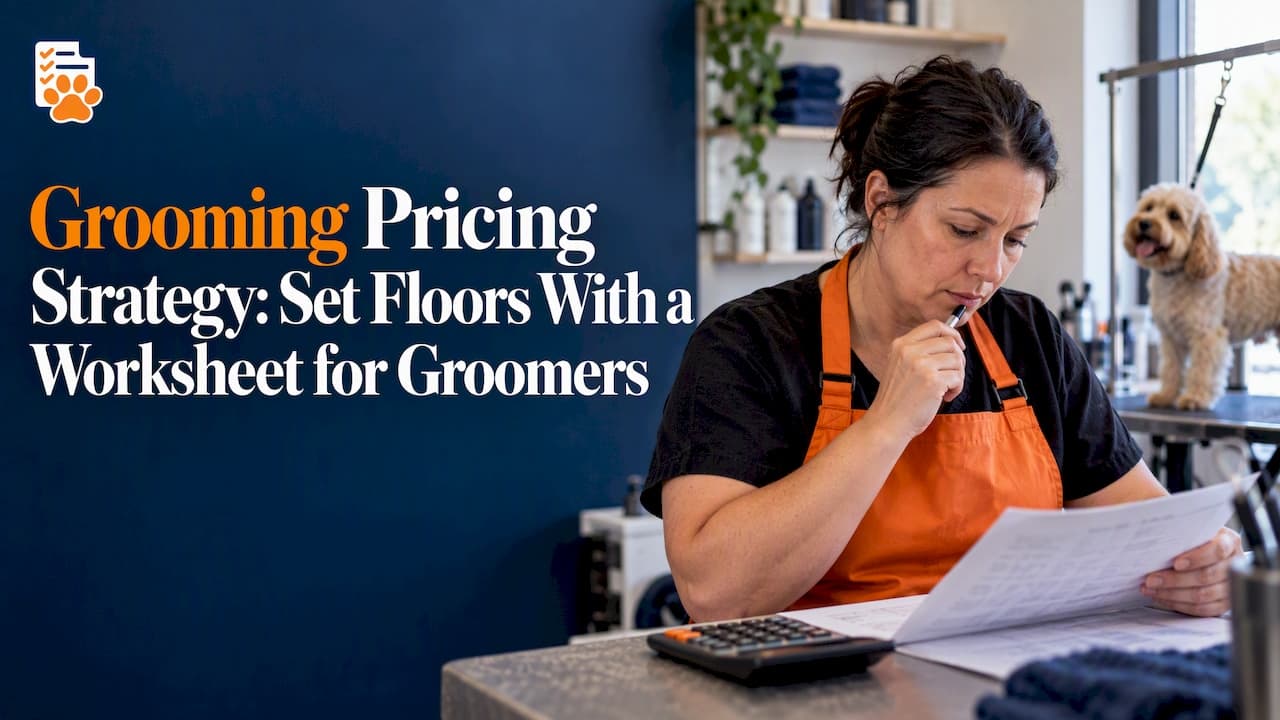
Set a cost-based price floor first, then layer in time-based tiers, value-based add-ons, and simple packages to raise your average ticket. A worksheet that walks through fixed costs, billable grooms, and markup turns this from guesswork into a repeatable system, and editable templates from resources like PawBizWorks can help you roll it out across your price sheet. Author Emmanuel breaks down the exact calculation below.
TL;DR:
- At 100 grooms, $2,000 in fixed costs adds $20 overhead per groom; with $8 supplies and $25 wages, the cost floor is $53 before profit.
- Track appointment time, including cleanup, client check in, and scheduling gaps, before pricing; unbilled work can shrink the margin your calculations appear to protect.
- Set tiers by appointment time and coat complexity, not weight alone; price matting, special handling, and optional services separately when they add labor.
- Mobile groomers must count fuel, travel, maintenance, and onboard utilities, then charge a trip fee or build those costs into base prices.
- Review prices at least yearly, give clients advance notice, and test increases with a small group of regular clients before changing the full menu.
Table of Contents
- Pricing methods: cost-based, time-based, value-based, and incentivized
- How to calculate costs, set a price floor, and choose a markup
- Practical pricing tiers: pricing by size, time, and complexity
- Add-ons, packages, and bundling without confusing clients
- Mobile grooming vs. shop pricing: charging for travel and convenience
- Raising prices, discounts, tipping, and client trust
- Templates, worksheets, and tools to implement a pricing strategy
- What groomers get wrong about pricing
- Get your pricing system running this week
- FAQ
- Sources
Pricing methods: cost-based, time-based, value-based, and incentivized
Most grooming businesses end up blending four pricing approaches rather than picking just one. Knowing what each does well helps you decide where to lean.
Cost-based pricing starts with your actual expenses: supplies, labor, rent, insurance, and overhead, then adds a margin on top. It protects your business from the common trap of pricing by instinct and ending up underwater on certain breeds or coat types. Every price you set should clear this floor, no matter what else influences the final number.
Time-based pricing scales price with how long a groom actually takes. A double-coated Husky in full shed takes longer than a short-haired Chihuahua, and your pricing should reflect that directly rather than relying on breed assumptions alone. This method works especially well once you have tracked actual appointment times for a few weeks.
Value-based pricing applies to specialty services where clients pay for outcomes, not minutes: show-quality hand scissoring, de-shedding treatments, or premium spa add-ons. Here, price reflects skill and results more than raw time spent.
Incentivized pricing uses discounts, loyalty rewards, and prepaid packages to influence behavior rather than cover costs directly. Used sparingly, these tools can:
- Smooth out slow weekdays by discounting off-peak slots
- Lock in repeat revenue through prepaid session packages
- Reward referrals without permanently lowering your base rates
The strongest pricing structures use cost-based pricing as the non-negotiable floor, time-based logic to differentiate standard services, and value-based or incentivized pricing layered on top for specialty work and client retention.
How to calculate costs, set a price floor, and choose a markup
Your price floor is the lowest amount you can charge for a given groom without losing money. Getting there requires tracking a handful of cost buckets honestly, including the ones groomers tend to forget.
Start with these categories:
- Direct supplies: shampoo, conditioner, blades, cologne, and other per-groom consumables.
- Labor per groom: your own wage expectation or an employee's hourly rate, converted into time per appointment.
- Fixed overhead: rent, utilities, software, insurance, and loan payments, spread across your monthly billable grooms.
- Taxes and insurance: liability coverage and the tax reserve you set aside per service.
- Mobile-specific costs: fuel, vehicle maintenance, and water or power systems, when they apply to your setup.
Once you have those numbers, the calculation flow looks like this: take your total monthly fixed costs, divide by the number of billable grooms you realistically complete each month, then add your variable per-groom costs and your target wage per groom. That total is your cost per groom, or price floor. Anything you charge above that number is profit margin, which is where your markup decision comes in.
Markup is the percentage you add to cover profit beyond covering costs and wage. A common approach is to decide what hourly rate you want to earn after expenses, then divide that by how many grooms you can realistically complete per hour to get a per-groom profit target.
Pro Tip: Track your actual billable hours before finalizing your floor. Groomers routinely underestimate non-billable time spent on cleanup, client check-in, and scheduling gaps, which quietly erodes margin if it is not priced in.
Here is a simplified illustrative example. Say your monthly fixed costs total $2,000 and you complete 100 billable grooms a month, that is $20 per groom in overhead. Add $8 in supplies and a $25 wage target per groom, and your cost per groom lands at $53. If you want a $15 profit margin on top, your price floor becomes $68 for that standard groom. This is a worked example using generic numbers to illustrate the method, not a market rate.

Practical pricing tiers: pricing by size, time, and complexity
Time is the most reliable proxy for grooming price because it correlates directly with labor cost, regardless of breed. A terrier with a short coat and one with heavy matting can take very different amounts of time, even though they weigh the same.

Start by timing a handful of real appointments across your typical coat types and sizes to build baseline duration estimates. From there, convert those time blocks into tiers using your price floor and markup from the previous section: a shorter groom and a longer groom should not share a price, even if the dogs are similar sizes.
Use these rules to adjust tiers for complexity:
- Add a flat matting fee or an hourly de-matting rate when coat condition pushes a groom past your standard time estimate.
- Price long-haired breeds in a separate tier from short-haired breeds of similar size, since brushing and drying time differ significantly.
- Build in a small anxious-dog or special-handling surcharge when a groom requires extra breaks, muzzle use, or a calmer pace.
- Charge separately for add-on services like nail grinding, teeth brushing, or ear plucking rather than folding them into a base tier.
Breed-based pricing lines can work well for a shop that specializes in a narrow set of breeds, since clients already expect breed-specific service language. For a general practice, breed lists can confuse clients and create pricing disputes when a mixed breed does not fit cleanly into a category. Size and time-based tiers tend to generalize better across a varied client base.
Add-ons, packages, and bundling without confusing clients
Add-ons and packages raise your average ticket without forcing you to raise your base prices. The key is choosing additions that are easy for clients to understand and genuinely add value.
High-value add-ons worth pricing clearly include teeth brushing, nail grinding, de-shedding treatments, paw balm, and seasonal spa add-ons like blueberry facials. Price simple add-ons as a flat fee and reserve percentage-based pricing for time-intensive extras like de-shedding, which scales with coat density.
Packages work well in a few formats:
- Prepaid bundles of multiple sessions at a modest discount to lock in repeat visits.
- Monthly membership plans that bundle a standard groom with selected add-ons at a flat recurring rate.
- Tiered packages, such as "Basic," "Spa," and "Deluxe," so clients can self-select based on budget rather than negotiating individually.
Menu design matters as much as the pricing itself. Group add-ons by purpose, such as "coat care" and "comfort extras," and keep descriptions to a single clear sentence each so clients can scan and decide quickly. A price sheet that reads like a spa menu, with short descriptions and visible tiers, tends to convert better than a flat list of services and numbers.
Mobile grooming vs. shop pricing: charging for travel and convenience
Mobile grooming carries cost categories a shop never deals with: fuel, drive time between appointments, vehicle maintenance, and water or generator systems if your van is self-contained. These costs need to be folded into your price floor the same way rent and utilities are for a shop.
You generally have two ways to charge for the convenience of mobile service:
- A flat per-trip surcharge added on top of your standard groom price.
- A built-in premium where your base price already reflects mobile overhead, with no separate line item.
Setting a booking minimum per route, or offering a small discount for clients who book alongside a neighbor on the same street, helps keep drive time profitable. When explaining a convenience fee to clients, frame it around what they are getting: no drop-off, no waiting room, and a groom completed at their own driveway, which justifies the premium far better than listing fuel costs.
Raising prices, discounts, tipping, and client trust
Review your pricing at least once a year, or sooner if a specific cost, like rent or supply prices, jumps significantly. Waiting too long to adjust is one of the most common ways groomers quietly lose margin.
- Give clients advance notice before a price increase takes effect.
- Pair the announcement with a short reminder of what they are paying for: your time, training, and the products used.
- Consider grandfathering long-term clients at a slightly reduced increase for one cycle to soften the transition.
- Keep loyalty discounts occasional and tied to specific actions, like referrals, rather than a standing expectation, to avoid training clients to wait for a deal.
Tipping in grooming varies by region and relationship with the groomer, and most shops leave it as the client's discretion rather than adding a mandatory service charge. If you choose to build in a service charge instead of relying on tips, say so clearly on your Google Business Profile price sheet so there is no confusion at checkout.
Pro Tip: Announce price increases in person or by direct message rather than a generic mass email. Clients respond better to a personal heads-up than to a surprise on their next invoice.
Templates, worksheets, and tools to implement a pricing strategy
Turning this method into a real price sheet is mostly a matter of working through the worksheet steps in order: list your fixed costs, estimate your realistic number of billable grooms per month, compute your cost per groom, apply your markup, build your tiers from there, and finally layer in your add-on menu.
A few template types make this process faster to execute:
- A price sheet template you can edit directly once your tiers and add-ons are finalized.
- A client notice email template for announcing price changes clearly and professionally.
- Package terms and conditions covering prepaid sessions and cancellation policy.
- A membership welcome kit for clients who sign up for recurring plans.
If you would rather not build these from scratch, our Pet Business Pricing & Profit Kit includes resources to help with pricing, and our guide to starting a dog grooming business covers the setup steps that come before pricing.
What groomers get wrong about pricing
The combination of leaving out overhead and non-billable time entirely and pricing only around supplies and the visible minutes of a groom is a common mistake. That alone can quietly cost a shop its real profit margin every month.
If you take one action from this article, run the worksheet this week and set a defensible price floor based on your actual numbers, not a competitor's price sheet. Test the new pricing with a small group of regular clients before rolling it out shop-wide, so you can adjust before announcing it broadly.
— Emmanuel
Get your pricing system running this week
We built our template kits to help with pricing work, so you are not starting from a blank spreadsheet. Our Pet Business Pricing & Profit Kit offers pricing resources, our Dog Grooming Business Starter Kit includes grooming-specific templates, and our Booking & Scheduling Management Kit offers booking and scheduling resources.

Our kits include editable files you can customize for your business. A typical path looks like this: fill out the cost worksheet, export your finished price sheet, then send your client notification using the included template, all in one sitting. Browse the full template catalog to find the kit that matches where your pricing project stands right now.
FAQ
What is the average tip for a groomer?
Tipping in grooming varies widely by region and relationship with the client, and there is no single standard percentage. Tip amounts vary, and clients may leave a tip at their discretion rather than paying a required charge.
What are common mistakes made during dog grooming?
Common pricing-related mistakes include underestimating non-billable time, failing to charge separately for matted or long coats, and not accounting for overhead costs like insurance and utilities. These gaps quietly shrink profit margins even when a grooming business appears busy.
What are the startup costs for a pet grooming business?
Startup costs typically include grooming equipment, supplies, insurance, and either shop rent or a mobile van setup, and they vary significantly depending on whether you operate mobile or from a fixed location. Our guide to starting a dog grooming business walks through the specific setup categories in more detail.
How much does it cost to groom a dog?
Pricing for a dog depends heavily on coat type and groom complexity rather than weight alone, since a short-haired breed and a heavily matted long-haired breed can require very different amounts of time. Calculating your own cost-based price floor, then applying a time-based tier for that size and coat type, gives a more accurate number than relying on a generic weight chart.
Sources
- U.S. Pet Industry Reaches $158 Billion in 2025, Poised for Continued Growth in 2026
- US pet owners spend 2.9% more on pet products in 2025 | Pet Food Processing
- APPA State of the Industry Report: US Pet Industry Hits $158B in 2025, Consumer Spending Shifts - Pet Age