
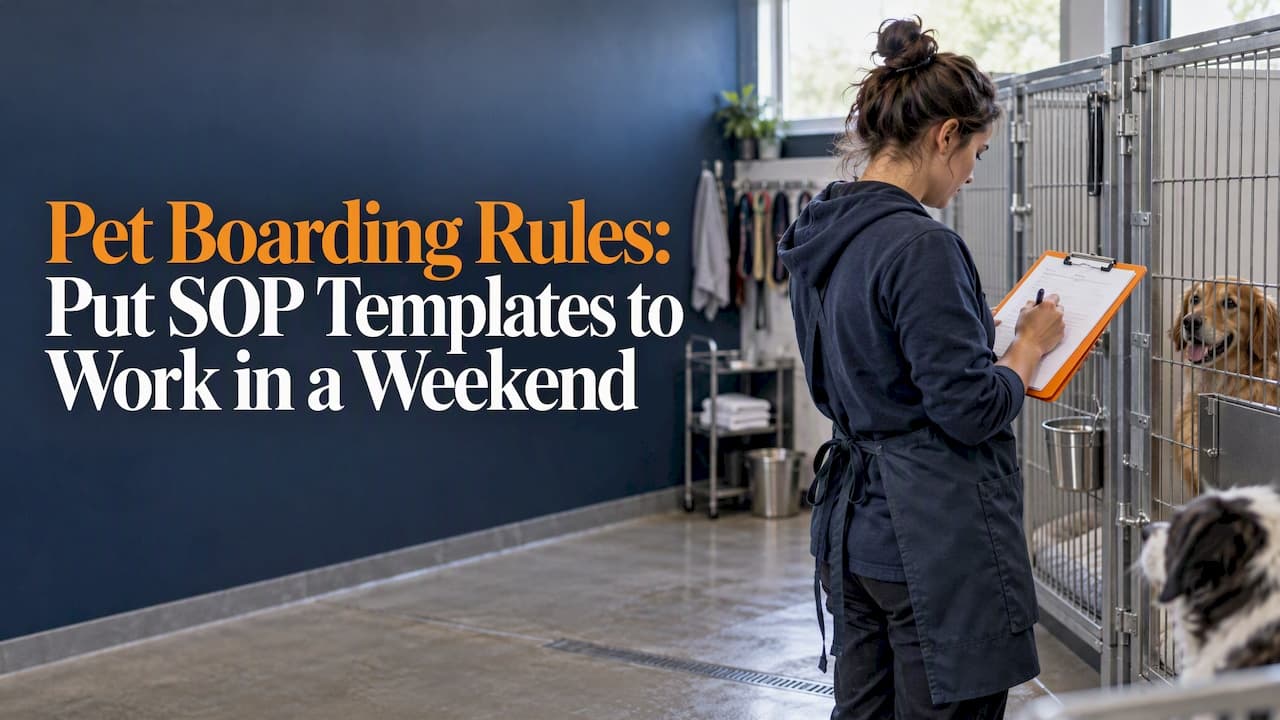
Every boarding facility needs a written ruleset that covers isolation procedures, vaccination and intake verification, cleaning and sanitation schedules, daily observation logs, a Program of Veterinary Care (PVC), and an emergency plan. These rules protect the animals in your care, satisfy inspectors, and give clients confidence in your facility. Ready-made templates and SOPs can turn this list into working documents in a weekend instead of a month.
TL;DR:
- Keep a physically separate isolation area with dedicated, clearly marked equipment, and verify vaccinations, emergency contacts, and a health history covering the previous 14 days before intake.
- Clean primary enclosures at least twice daily, remove waste and soiled bedding promptly, and keep dated logs inspectors can verify without relying on memory.
- Observe and log each animal’s health, appetite, and behavior every 24 hours; record medication time, amount, and staff initials on its individual file.
- Have clients sign consent for treatment, medications, and image use, and state cancellation fees, late pickup charges, and abandoned pet procedures consistent with law.
- Confirm local license and renewal requirements, then prepare an emergency plan that assigns staff roles and covers evacuation, ongoing care, and shelter arrangements elsewhere.
Table of Contents
- Animal health and disease control rules operators must document
- Cleaning, sanitation and facility standards that keep inspectors satisfied
- Daily care, observation and medication rules for boarded animals
- Client policies your intake forms and contracts need to cover
- Licensing, inspections and emergency planning requirements
- Templates and SOPs that turn these rules into daily practice
- Enforcing rules without losing client trust or staff morale
- Put these boarding rules into practice with ready-made templates
- FAQ
- Sources
Animal health and disease control rules operators must document
A documented isolation plan is the backbone of disease control in any boarding facility. Set aside a physical space, separate from general housing, with its own signage, airflow, and equipment. Cleaning tools used in isolation should never touch the general population: color code mops, bowls, and towels so staff cannot mix them up by accident.
Intake screening comes next. Before any animal enters your facility, confirm:
- Proof of core vaccinations, plus bordetella and canine influenza vaccination where recommended for group settings, according to the American Veterinary Medical Association
- A signed intake form with emergency contact and veterinary authorization details
- A current health declaration from the owner covering symptoms in the past 14 days
When a boarded animal shows signs of illness, isolate it immediately, contact a veterinarian within 24 to 48 hours where symptoms warrant it, notify the owner the same day, and log every animal that may have had contact with it.
During documented canine influenza clusters, rapid isolation, active surveillance, and voluntary facility closure were the measures that actually contained spread, according to CDC's Emerging Infectious Diseases outbreak analysis. Vaccination lowers risk but does not guarantee an outbreak stays out of your building, which is why isolation protocols and surveillance matter even in a fully vaccinated population. Some health authorities have used isolation windows of several weeks for suspected cases during active outbreaks: build that flexibility into your SOPs and retain your exposure records accordingly.

Cleaning, sanitation and facility standards that keep inspectors satisfied
Primary enclosures need cleaning at least twice daily in most state frameworks, with waste and soiled bedding removed before odors or residue build up. Approved sanitation methods generally include a hot water wash followed by a detergent and disinfectant cycle, or steam cleaning for surfaces that tolerate it.
- Choose impervious, easy-to-sanitize materials for floors, walls, and enclosures rather than porous surfaces that trap bacteria
- Route waste and wash water through drainage that meets local plumbing codes
- Monitor ventilation and ammonia buildup, since poor airflow is one of the fastest ways to make healthy animals sick
- Run a documented pest control program and watch for droppings, chewed packaging, or structural gaps as early warning signs
Pro Tip: Keep a dated cleaning log at each enclosure or kennel bank so any inspector can verify frequency without asking staff to reconstruct it from memory.
Model regulations, including guidance adapted from Nebraska's commercial operator rules, specify acceptable sanitation temperatures, enclosure materials, and record retention periods that hold up well as a template even outside that state. Documentation is what separates a facility that passes inspection from one that gets a notice to correct for the same conditions.
Daily care, observation and medication rules for boarded animals
Written rules for daily care protect animals and give your staff a clear standard to follow every shift.
- Observe every boarded animal at least once every 24 hours and log health status, appetite, and behavior
- Record exercise and enrichment activity, especially for stays longer than a few days, so long-term boarders get real interaction rather than just a clean kennel
- Administer medication only under veterinary direction, from the original labeled container, and only with the owner's written consent
- Document every dose given, including time, amount, and staff initials, on the animal's individual record
- Retain daily logs and treatment records for a defined period, commonly a year or more, in case a dispute or health question arises later
A missed observation or an undocumented medication dose is the kind of gap that turns a minor incident into a liability problem. Build the recording habit into shift handoffs rather than end-of-day catch-up.
Client policies your intake forms and contracts need to cover
Your written rules are only half the job: clients need to see and sign the policies that affect their pet and their wallet.
- Collect vaccination history, emergency contacts, veterinary authorization, behavioral notes, current medications, and special needs on one intake form
- Get explicit consent for medical treatment, medication administration, use of sedatives or behavior management tools, and photography or image use in marketing
- Spell out cancellation windows, no-show fees, and late pickup charges so there is no ambiguity at checkout
- Define an abandoned-pet policy with a clear notification timeline, storage fee schedule, and disposition steps consistent with state law, an approach consistent with how state abandoned-property statutes frame operator protections
Clear, signed policies resolve most disputes before they start.
Licensing, inspections and emergency planning requirements
Boarding facilities operate under state and local rules that go beyond general business licensing.
- Confirm your license or permit status and renewal schedule with your local animal control or state agricultural board, following the model set by North Carolina's boarding kennel licensing process
- Expect inspectors to check structural soundness, sanitation, the isolation area, your written PVC, observation logs, fire and smoke alarms, and pest control
- Understand your state's notice-to-correct process: most jurisdictions give a correction window before escalating to fines or license suspension for repeat violations
- Write an emergency and disaster plan covering evacuation routes, continuity of care, off-site sheltering arrangements, and specific staff assignments
State boarding codes, including California's pet boarding facility statute, require written policies, isolation areas, daily observation, and emergency planning as baseline conditions for operating, not optional extras.
Templates and SOPs that turn these rules into daily practice
Writing every policy from scratch is where most new boarding operators lose weeks they do not have. A workable set of templates covers:
- An intake and consent form bundle covering vaccination, medical authorization, and behavioral history
- A vaccination verification checklist matched to your intake process
- Cleaning and disinfection logs formatted for daily sign-off
- An isolation area SOP with step-by-step staff instructions
- A daily observation log template for health, feeding, and medication tracking
- A written Program of Veterinary Care template ready for your veterinarian's review
- An emergency plan template and an abandoned-pet policy template
Editable templates cut training time for new staff because the same form teaches the procedure while it captures the record. Our Pet Business Templates & Forms collection, including the Complete Pet Business Management Mega Bundle, gives operators instant digital access to editable and printable versions built specifically for pet-care businesses rather than general office use.
Enforcing rules without losing client trust or staff morale
Rules work best when clients hear about them before drop-off, not during a dispute. We've found that posting policies visibly, reviewing them at check-in, and training staff to document incidents consistently prevents most friction. Apply every rule the same way for every client, and escalate gray areas to a manager rather than letting individual staff improvise. A written record, kept consistently, settles more disagreements than a conversation ever will.
— Emmanuel
Put these boarding rules into practice with ready-made templates
We provide a template library designed to help pet-care operators access inspection-ready paperwork without spending weeks drafting it from scratch. The Pet Boarding Business Starter Kit covers the intake, consent, and daily operations forms this article walks through, while the SOP & Operations Manual Kit gives you a framework for writing your isolation procedures, PVC, and staff training documents.

For the client-facing side, our Booking & Scheduling Management Kit handles intake confirmations and cancellation policies in formats you can email directly. Every template arrives as an editable file, so the wording can be adapted to your facility and printed or sent the same day. Browse the full template collection to see which bundle fits your current setup.
FAQ
What should a boarding facility's isolation area include?
An isolation area needs physical separation from general housing, clear signage, and its own cleaning equipment to avoid cross-contamination. Regulatory guidance consistently treats a designated isolation space as a baseline requirement, not an optional precaution, as reflected in federal and state sanitation standards.
Which vaccines should a boarding facility require at intake?
Core vaccines are the minimum, and most facilities also require bordetella and canine influenza vaccination because animals in group housing face higher exposure risk, a recommendation echoed by the AVMA's vaccination guidance. Acceptable proof typically includes a veterinary record or certificate dated within the past year.
How often do boarded animals need to be observed and logged?
Boarded animals should be observed and the observation logged at least once every 24 hours, covering health, appetite, and behavior. Facilities handling medication or long-term stays often log more frequently to catch problems early.
What does a written Program of Veterinary Care need to cover?
A written PVC should document disease prevention protocols, vaccination requirements, emergency care procedures, and staff training expectations, reviewed and signed by a veterinarian. Maintaining one is considered best practice even where it is not strictly mandated, per APHIS guidance on written veterinary care programs.
How should a facility handle a pet that is not picked up on time?
A written abandoned-pet policy should set a clear notification timeline, define any storage fees, and outline disposition steps that follow state law. Having this policy signed at intake protects the facility from extended liability and unresolved costs.
Sources
- Emergence and containment of canine influenza virus A(H3N2), Emerging Infectious Diseases (CDC)
- Vaccinating your pet | American Veterinary Medical Association
- California pet boarding facility code (Chapter 11)
- NCDA&CS boarding kennel license application and guidance